
Arrest Warrants in Bay County
In Bay County, an arrest warrant is a judicial command built on an accusation, not a missed court date. A complaint gets filed first. A judge or authorized magistrate then reviews the probable-cause showing. If it holds up, the signed warrant tells officers to arrest the person named and bring them before the court. The paper identifies the offense. It does not prove it. Where the case goes depends on the charge. Misdemeanor, traffic, and city ordinance matters belong to the 74th District Court, which covers all of Bay County. Felonies start in district court with a preliminary examination and continue in the 18th Circuit Court after bindover. Both courts share the same Bay City building, in different suites.
MCL 764.1b and Bay County Warrants
Michigan draws the anatomy of an arrest warrant in MCL 764.1b. That statute requires the warrant to state the substance of the accusation, direct it to a peace officer, and command the arrest of the person named. It must also require a prompt appearance before a magistrate or judge, with the process returned under law. The state benchbook fills in the working details for Bay County and every other county. The warrant identifies the accused by name or description and names the offense. The judicial officer who issued it signs it. An interim bail amount may already be written on the face of the warrant.
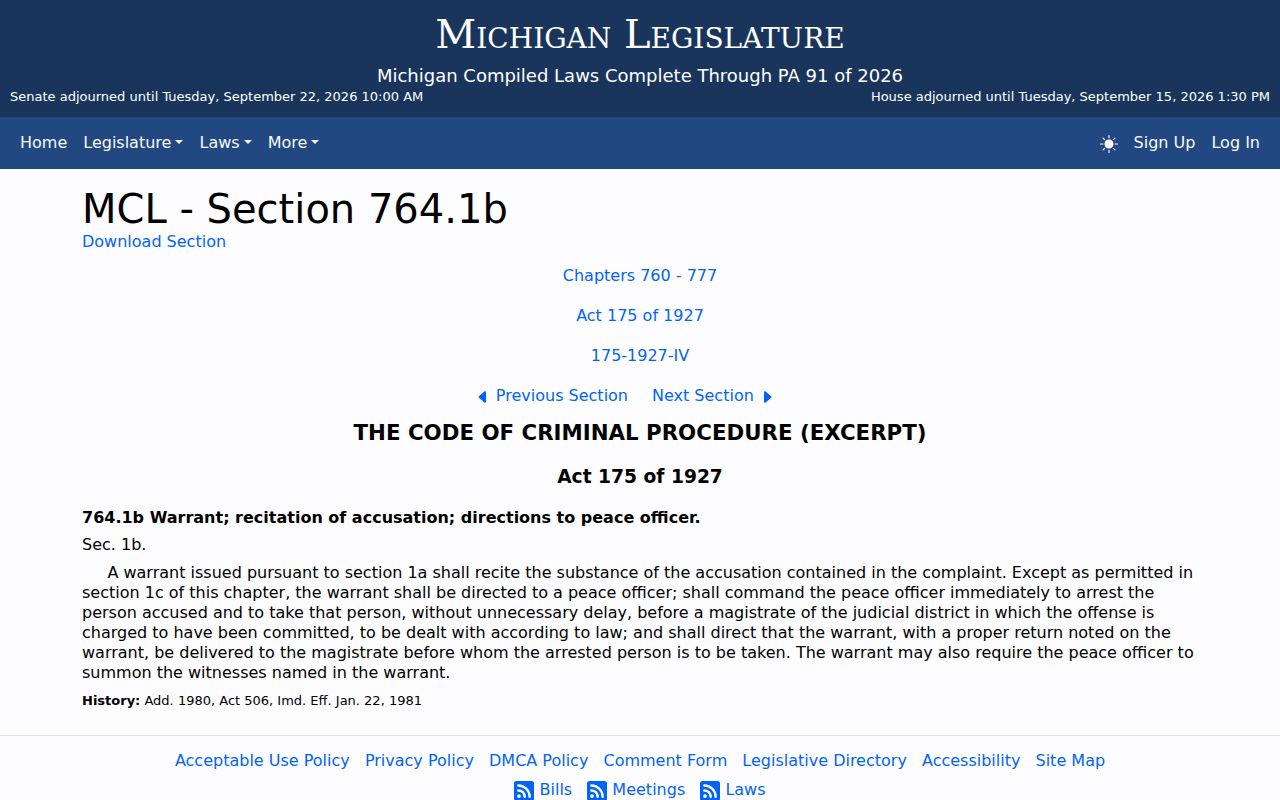
That statute is why a Bay County warrant question starts with the court. No police list can answer it.
Bay County Arrest Warrant Issuance Steps
Issuance follows a short sequence, and each step leaves a different record behind.
- A complaint or charging document reaches the court with supporting probable-cause material.
- A judge or authorized magistrate reviews the showing and signs the warrant if the legal standard is met.
- The clerk dockets the case in the court with jurisdiction, usually the 74th District Court.
- The process is passed to the sheriff, a city police department, or another authorized officer for service.
- After an arrest, the court handles arraignment, counsel, and bond, and the sheriff handles transport and booking.
Michigan law also lets a magistrate issue certain warrants on written authorization from a prosecutor or municipal attorney. So in Bay County, not every warrant carries a judge's signature.
What a Bay County Arrest Warrant Contains
A warrant is a short document. In Bay County, most of what a reader needs sits in the top third. The field list below follows the statutory elements and the state benchbook.
| Warrant or Case Number | The clerk's file number, for example 24-001234-FY |
|---|---|
| Court and County | The 74th District or 18th Circuit Court, Bay County |
| Person Named | A name or, when the name is unknown, a description |
| Offense or Accusation | The substance of the charge behind the process |
| Issuing Officer | The judge or magistrate who signed the warrant |
| Interim Bail | Any amount or condition noted at issuance |
| Command and Return | The direction to arrest and the return requirement |
A Bay County felony case may later carry a circuit-court docket number after bindover.
How Bay County Arrest Warrants Are Served
Once a Bay County judge signs an arrest warrant, the paper goes to whoever can physically pick the person up. Most often that means the Bay County Sheriff's Office, though a city police or public-safety department, or another authorized officer, can serve it too. The sheriff works out of the Law Enforcement Center on Third Street, and the records its deputies create, including service, arrest, and booking paperwork, stay in that office's files. Not every attempt ends in handcuffs, though. An officer may make the arrest, or may come back and note that the address came up empty. Bay County publishes no field-by-field service log, so the practical move is a specific record request naming the warrant rather than a vague question at the counter.
Records Behind a Bay County Warrant Arrest
Three record sets describe one Bay County arrest, and they sit in different offices. The court holds the complaint, the warrant, the docket, and the bond order. The arresting agency holds the service, transport, and booking records. The jail holds custody information. The county says prior incarceration details are not released without proper authority. Sheriff-held material can be requested through the county open-records process.
Public case search tools in Bay County point to a docket, but the official file still comes from the clerk.
Note: A records request retrieves existing documents, and it cannot produce a certificate that no warrant exists.
Arrest Warrant vs Summons vs Bench Warrant
Michigan courts pick from several tools, and the choice signals where a Bay County case is headed. A summons asks you to appear without an arrest. A bench warrant answers a missed obligation inside an existing case. An arrest warrant authorizes custody on a new accusation.
| Feature | Arrest Warrant | Summons | Bench Warrant |
|---|---|---|---|
| Basis | Complaint and probable cause | Filed charge, no custody sought | Missed date or violated order |
| Custody | Authorizes arrest | No arrest at the start | Authorizes arrest |
| Who Issues It | Judge or magistrate | The court | The judge on the case |
| First Step | Arraignment after arrest | Appear on the date given | Appear, comply, or move to recall |
A Bay County bench warrant can also follow a missed date in a case that began with a summons.
Interim Bail and Bay County Arrest Warrants
An interim bail figure written on a warrant is only a starting point. The court sets the operative bond. The jail then explains how payment works. Bay County says bond information is available by phone at any hour, with money orders, certified checks, and cash accepted and made payable to the prisoner. Personal checks are not accepted. Release processing can take a couple of hours after the court acts. A separate hold from another court or agency can still keep a person in custody after one bond is handled.
Bay County Searches and Sealed Warrants
A Bay County warrant can exist without appearing in any public search. Federal and state process may stay sealed while an investigation is active, and protected case types never reach a public portal. Michigan's Law Enforcement Information Network carries warrant entries for authorized criminal-justice users only. No resident can search it.
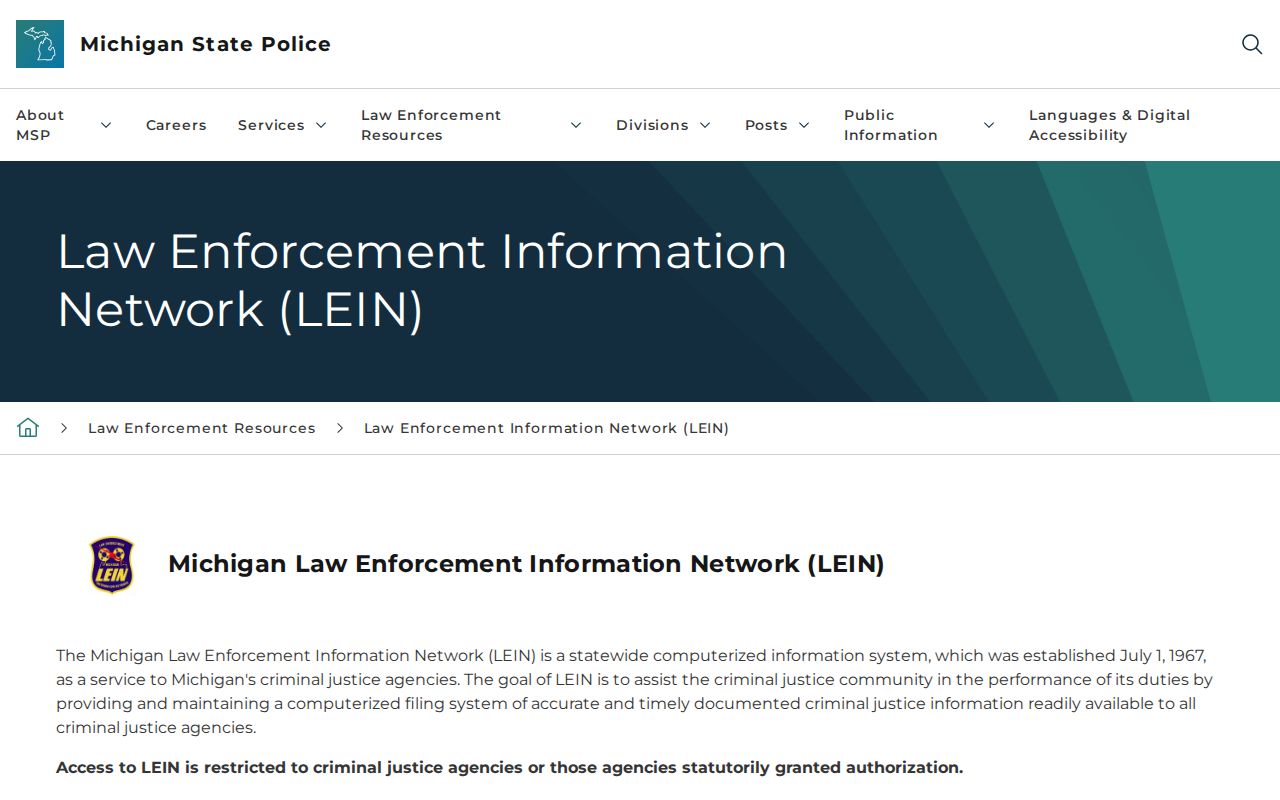
That restriction is why a Bay County public search cannot replace a call to the court.
Note: A public case search is informational, and a missing result never proves that no process was issued.
What to Do If There's a Warrant for You
Call the issuing court first and ask what the case requires. Michigan Court Rule 6.105 sets out a voluntary-appearance path for people who come to the court on their own. A Bay County court applies that rule with exceptions for assaultive or domestic-violence allegations and repeat failures to appear.
Important: Talk with a lawyer before surrendering, because a voluntary appearance is a legal step and not a guaranteed release.
Call first. Ask whether you can walk in to surrender, what the bond amount runs, and if a motion to recall should come first. For the fuller playbook, see what to do if you have a Bay County warrant.
Federal Arrest Warrants Near Bay County
Federal matters do not run through Bay County courts. They belong to the U.S. District Court for the Eastern District of Michigan and the U.S. Marshals Service. The district has a Bay City location on Washington Avenue, and the clerk's office there can walk you through docket procedures without unsealing sealed material. The Marshals Service also keeps a Bay City office for federal fugitive work, which an Eastern District page shows.
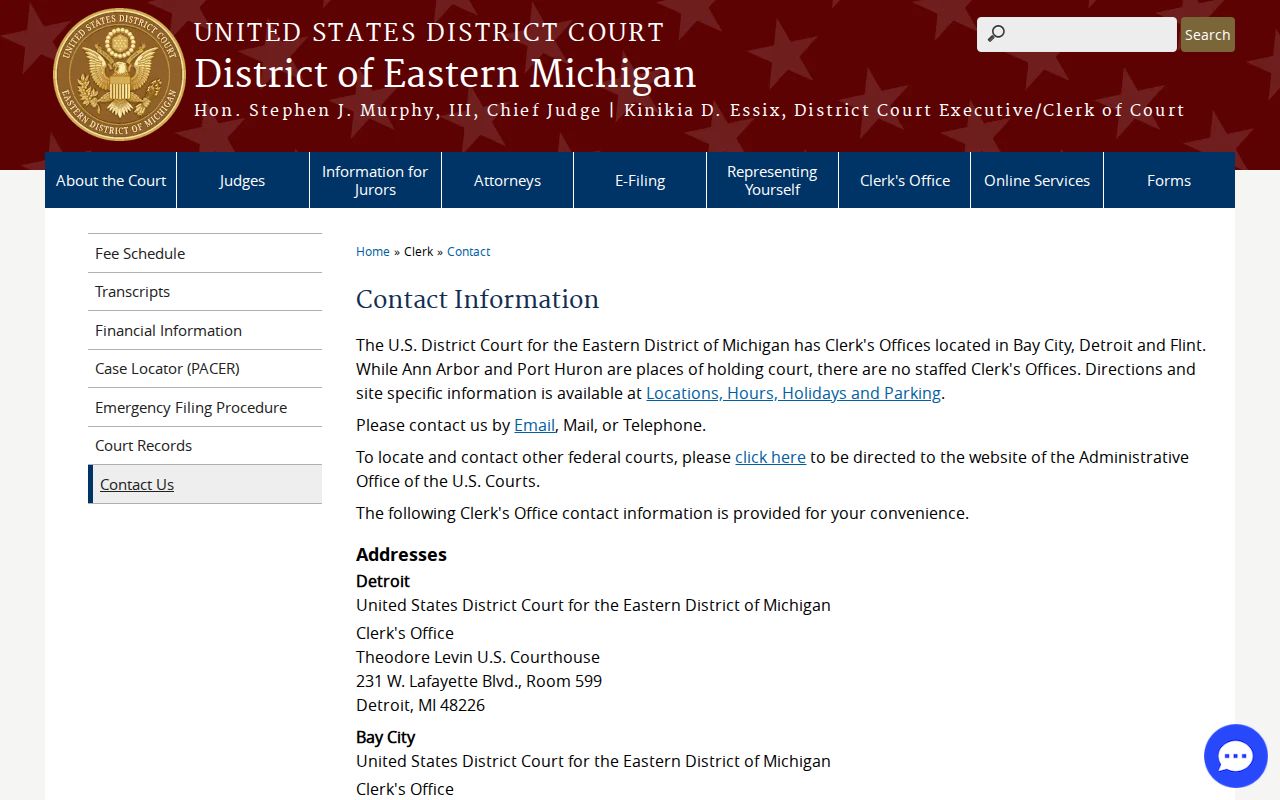
A Bay County court call cannot clear a federal case. Public dockets on PACER never display sealed process.