
Municipal Court Warrants in Bay County
Plenty of states let a city run its own courtroom, with its own judge, its own clerk, and its own warrant list to match. Bay County takes a different route. Its official court structure names three courts: the 18th Circuit Court, the Probate and Family Court, and the 74th District Court. The district court covers every corner of Bay County, city and township alike. That means a city ordinance ticket, a traffic citation, and a misdemeanor case started by a city officer all land in one shared docket. When a citation goes unanswered or a court date gets missed, the warrant that follows is a district-court bench warrant. Michigan uses that term for process issued after a failure to appear or a violated order.
Note: Michigan sources use bench warrant and failure-to-appear language, and no Bay County office uses a fine-collection capias label.
Michigan's 1969 Shift and Bay County Warrant Courts
Michigan folded most municipal court work into district courts in 1969, and Bay County still shows the effects. One countywide district court does the job now. Three elected judges sit there, each serving a six-year term, in the court facility on Washington Avenue in Bay City. The court handles traffic and civil infractions, misdemeanors, some ordinance violations, and felony preliminary examinations. It also takes arraignments, bail and bonds, plus civil claims under a statutory limit. That reach explains why city citations end up here instead of a hearing room at city hall.
Which Cities Have Municipal Courts
Bay County's four incorporated cities run no municipal courts of their own, and none of them posts a city warrant list. Every citation ends up in the same district court instead.
| City | Local Court | What It Handles | Contact |
|---|---|---|---|
| Bay City | No city court; 74th District Court | Traffic, ordinance, misdemeanor | (989) 895-4232 |
| Essexville | No city court; 74th District Court | Traffic, ordinance, misdemeanor | (989) 895-4232 |
| Auburn | No city court; 74th District Court | Traffic, ordinance, misdemeanor | (989) 895-4232 |
| Pinconning | No city court; 74th District Court | Traffic, ordinance, misdemeanor | (989) 895-4232 |
The 74th District Court page is the county's own description of that jurisdiction.
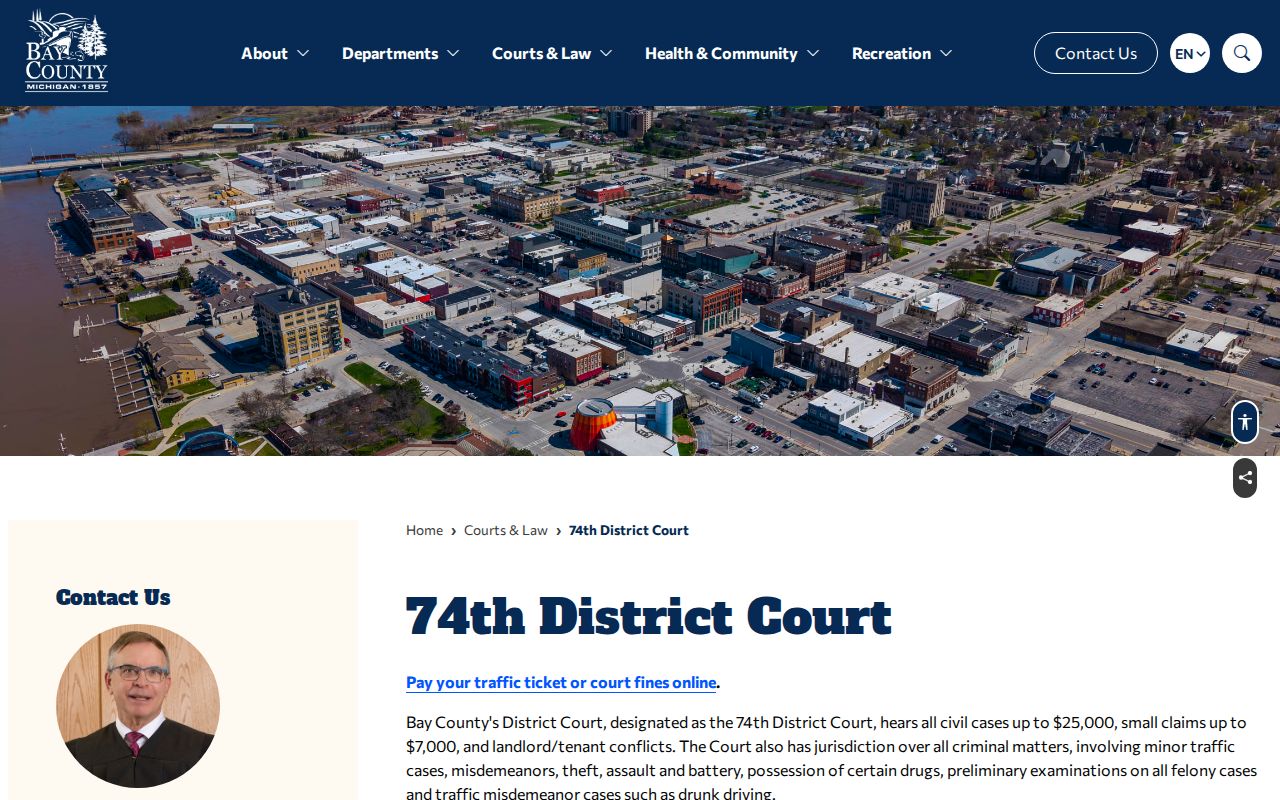
That page also lists the court's address and main phone number for case questions.
Where Bay County Ordinance Cases and Warrants Land
A ticket from a city officer can feel like a city hall problem. It isn't. In Bay County, every city code citation gets filed in district court, where a district judge applies the ordinance along with the state's civil-infraction rules. That is why a call to city hall rarely settles a case-status question. Call the court instead. Civil infractions, arraignments, and bonds all run through the same place, so one phone number covers case status for all four cities.
How to Check a Municipal Court Warrant
The district court serves every city, so a Bay County warrant check works the same way wherever the ticket came from. Use the channels that can answer. Skip the ones that can't.
- Search the 74th District Court case look-up with the case or citation number.
- Call the district clerk at (989) 895-4232 and ask what the docket shows.
- Check the docket calendar for a hearing date the clerk can confirm.
- Call the city police or public-safety department only for the report it created.
- Call the sheriff's Records Division at (989) 895-4050 if a county deputy served the process.
Note: There is no city warrant portal to search, so a blank result on any public page proves nothing.
City Police Are Not Bay County Warrant Courts
A city police department answers for what its officers did: a stop, a citation, an arrest, a report. It sets no bond and recalls no warrant. Those calls belong to the court holding the case. The line matters when someone phones a police desk to ask whether a Bay County warrant exists. Staff may know of a service attempt on their own paperwork, but only the court file says whether process is still open. The court's own warrant page shows that division of authority.
Felony matters that start with a city citation can also climb to Bay County circuit court after bindover.
What a Municipal Court Warrant Shows
A district-court warrant record in Bay County carries the same working fields as any Michigan process. The city name shows up only as part of the offense or issuing agency.
| Case or Citation Number | The clerk's file number, for example 24-001234-OM |
|---|---|
| Person Named | The person cited or charged, matched to a birth date in court systems |
| Offense | The city ordinance, traffic infraction, or misdemeanor |
| Issuing Court | The 74th District Court, countywide |
| Issuing Agency | The city police or public-safety department, or the sheriff |
| Status | Issued, active, served, recalled, or satisfied |
The city that wrote the ticket is not the office that clears the warrant.
Why Bay County Warrant Rosters Do Not Exist
No Bay County city posts a warrant list, and the sheriff publishes none either. That is uniform policy, not a gap on one site. Warrants live in court files. Public access to those files runs through court-records rules, not a city website, and a city has no authority to publish a court's process.
Resolving a Municipal Court Warrant
Resolution starts with the district court, and the path turns on the underlying case. A missed ticket date, an unpaid fine, and a criminal charge each take a different step in Bay County.
- Confirm the case number and current status with the district clerk.
- Ask whether the court accepts payment, a payment plan, or a new date.
- Ask whether a motion to recall or quash is needed.
- Talk with a lawyer before appearing if the charge is criminal.
- Keep written confirmation that the process was withdrawn.
Caution: A payment receipt does not always recall a warrant, so ask the court to confirm the case status in writing.
Bay County City Warrant Records Under State Law
Michigan's Freedom of Information Act covers what a city itself holds: policies, citation logs, and incident reports. A Bay County FOIA request goes to whichever city agency created the record. Court files are different. Courts are not public bodies under that law, so a warrant file held by a court never travels through a city request. Ask the city for documents it already has on hand. A policy, a procedure, an aggregate count, or a report you can name by date and number will do.
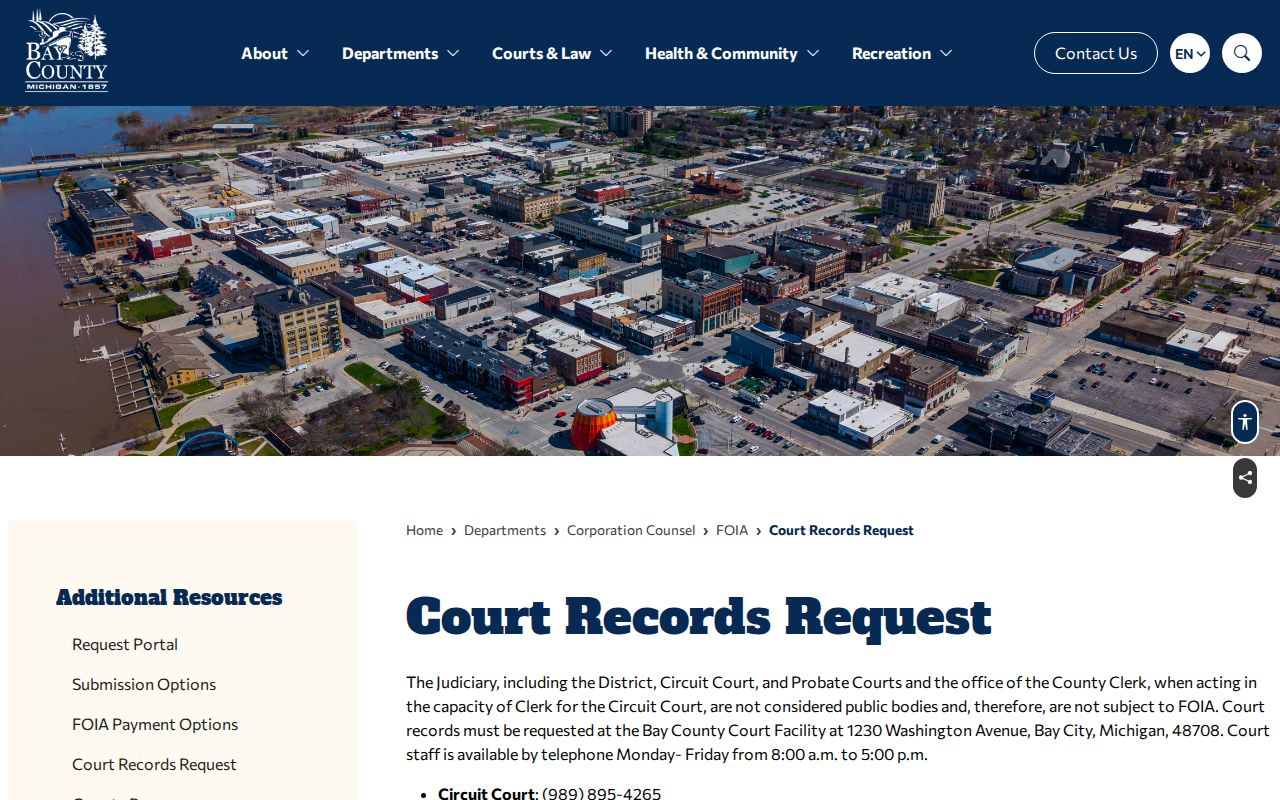
The state's own FOIA page spells out this split in plain terms. Reading it is the fastest way to see why a city request in Bay County cannot pull a court's warrant file.
Note: A court-record request and a public-records request are separate errands that go to separate offices with separate rules.
Auburn's Contracted Service and Bay County Warrants
Auburn shows why city labels can mislead anyone tracing a Bay County warrant. The city buys its police service from the Bay County Sheriff's Office under a contract shared with Williams Township. So a traffic citation written in Auburn may come from a county deputy rather than a city officer. The destination stays the same no matter who wrote the ticket. An Auburn citation still files in the 74th District Court. A deputy's service record stays with the sheriff.